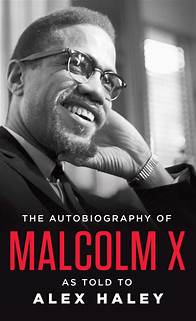

The Autobiography of Malcom X
Author: Alex Haley
A Story of Pain, Power, and Transformation
Few books strike as deeply as The Autobiography of Malcolm X. Told through the raw and honest voice of Malcolm himself — and masterfully assembled by journalist Alex Haley — this autobiography is a vivid account of a man who journeyed through fire and found his voice in truth, discipline, and fearless conviction. First published in 1965, shortly after his assassination, the book has become a landmark of American literature, politics, and Black consciousness.Stephen R. Covey’s The 7 Habits of Highly Effective People isn’t just a self-help book — it’s a roadmap for meaningful living. Since its release in 1989, this bestselling classic has transformed millions of lives by shifting focus from quick fixes to deep, principle-centered growth. Covey’s wisdom bridges personal, professional, and social development, showing us, that success is not just what we achieve, but who we become.
A Childhood of Pain and Separation
Born in 1925 as Malcolm Little, his early life was marked by trauma. His father, Earl Little, was a Garveyite preacher who believed in Black pride and self-reliance. Malcolm grew up witnessing his father’s violent death — likely at the hands of white supremacists — and the psychological breakdown of his mother, Louise Little, who was later institutionalized. The family was shattered by systemic racism.
In school, Malcolm was intelligent and ambitious but crushed by low expectations and racist teachers. He was once told that being a lawyer wasn’t a realistic goal for a “Negro.” That moment killed his academic dreams. The deep wound of rejection and injustice planted a seed of rebellion — not just against individuals, but against the entire system that devalued Black lives.
The Streets, Crime, and Prison — A Life on the Edge
In his teenage years, Malcolm turned to the streets. He became “Detroit Red,” a sharp-tongued hustler moving between Boston and Harlem. His life was filled with nightlife, gambling, drugs, women, and crime — until it all came crashing down. He was arrested and sentenced to prison.
But in prison, something extraordinary happened. Malcolm encountered books. He began to read voraciously — history, philosophy, religion, and politics. Through reading and reflection, he discovered his voice and his mission. He joined the Nation of Islam, renounced his past, and took on a new name: Malcolm X. The “X” symbolized the loss of his African ancestral name and identity, stolen through slavery and colonialism.
The Rise of a Revolutionary
Upon release, Malcolm quickly rose to prominence as the most powerful spokesperson of the Nation of Islam. Charismatic, disciplined, and fiercely intelligent, he mesmerized audiences and challenged white America’s conscience. He spoke about Black dignity, the destructive legacy of slavery and racism, and the need for Black self-defense. He refused to ask for justice politely. He demanded it — unapologetically.
To many, he was a threat. To others, a prophet. He became one of the most feared and admired Black men in America.
Yet Malcolm’s journey was far from over.
“My alma mater was books, a good library.
Malcom X
I could spend the rest of my life reading,
just satisfying my curiosity.”
Breaking Away — A Global Awakening
Over time, Malcolm began to question the hypocrisy within the Nation of Islam. In 1964, after painful revelations and ideological differences, he broke away from the group and founded his own organizations: Muslim Mosque, Inc. and The Organization of Afro-American Unity.
Then came his pilgrimage to Mecca — Hajj. In Saudi Arabia, Malcolm saw something he never thought possible: people of all races worshiping side by side, treating one another as equals. He experienced a spiritual transformation. He realized that racism was not inherent in white people, but in a corrupt system. His vision expanded from Black nationalism to global human rights.
He returned from Hajj with a renewed heart, calling for international solidarity, unity among oppressed people worldwide, and a more inclusive understanding of Islam and humanity. His speeches became more balanced, more profound — but no less courageous.
Legacy of a Martyr
On February 21, 1965, Malcolm X was assassinated while speaking at the Audubon Ballroom in New York. He was just 39 years old.
But his life, voice, and vision were not silenced. His autobiography, finished posthumously by Alex Haley, became a beacon for generations of truth-seekers, revolutionaries, scholars, and young people hungry for meaning and justice.
Why This Book Still Matters Today
Malcolm X’s story is a testimony to the power of transformation. He did not come from comfort, privilege, or safety. He came from abandonment, rage, and loss — and used those scars as fuel to speak truth, fight oppression, and reclaim identity.
His journey teaches us that change is possible. That education is liberation. That faith and conviction can guide us through the darkest valleys. He reminds us to never accept the lies of inferiority, to never fear truth, and to always be willing to grow — even if it means breaking away from the very institutions that once empowered us.
 OLUMA
OLUMA 
Leave a comment